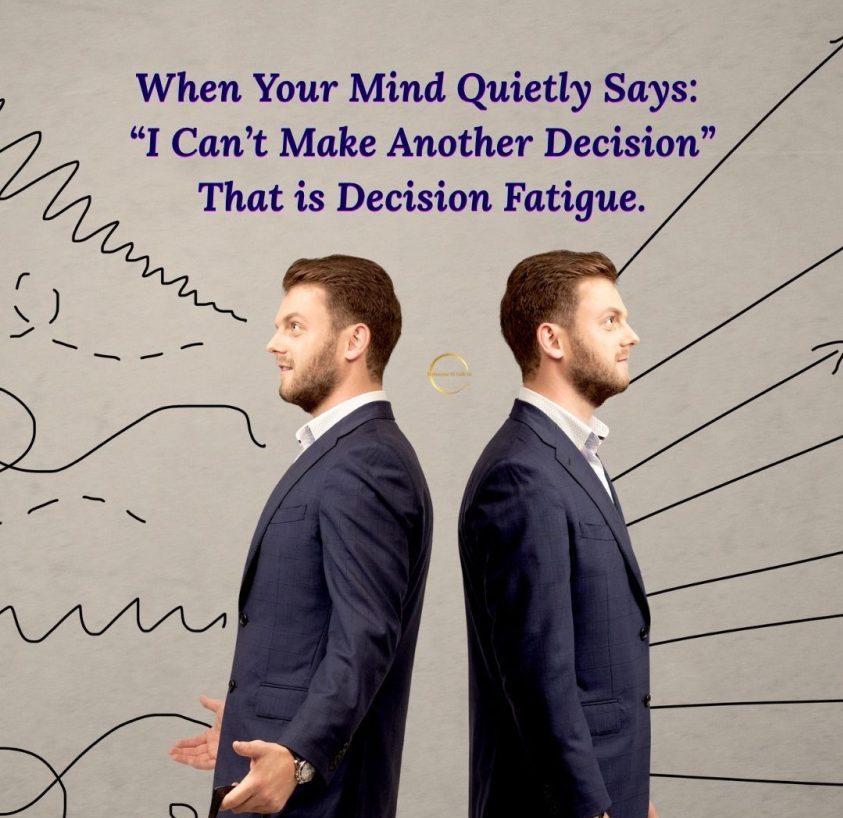
Sometimes it is not ordinary tiredness. Not the kind that disappears after coffee or an early night. Sometimes it feels as though even the smallest choices become heavy: What should I cook? Should I reply now or later? Which option is best? Am I making the right decision?
And although life may appear perfectly normal from the outside, internally there is a sense of overload. As if the mind has simply had enough of choosing.
Psychology calls this decision fatigue.
Research suggests that every decision, even small and seemingly insignificant ones, uses part of our mental energy. Over time, the brain begins looking for the easiest route: avoiding decisions, choosing the safest default option, or functioning on autopilot.
One of the most well-known studies examined judges making parole decisions. Researchers noticed that earlier in the day judges were significantly more likely to grant parole, while later decisions increasingly shifted towards refusal. After meal breaks, decision patterns reset again.
There is something deeply human in that.
Our minds were never designed to operate endlessly without pause.
Similar conclusions appeared in Roy Baumeister’s research on ego depletion, which explored how self-control and decision-making draw from limited cognitive resources. The more mental energy we spend regulating ourselves and making choices, the harder it becomes to stay focused and intentional later on.
Perhaps that is why even small evening decisions can sometimes feel overwhelming.
Interestingly, exhaustion does not only come from difficult choices. Research by Sheena Iyengar showed that too many options can become paralysing in themselves. When people were offered 24 varieties of jam, they were less likely to buy anything at all compared to those offered only six choices.
Sometimes the difficulty is not a lack of possibilities, but an excess of them.
And perhaps this helps explain why so many people today carry a quiet psychological exhaustion. Not only from work. But from constant choosing.
What to watch.
How to respond.
Who to become.
What to improve.
How to “do life properly”.
Maybe today you do not need another perfect decision. Maybe you need simplicity. Stillness. A little more space for your nervous system to breathe.
Because human beings were not created to live in a permanent state of choice.
Sometimes caring for yourself begins with allowing one less decision to sit on your shoulders.
Beata 🤗
Research sources:
PNAS – Extraneous factors in judicial decisions (Danziger i in., 2011)
https://www.pnas.org/doi/10.1073/pnas.1018033108
Journal of Personality and Social Psychology “Ego Depletion” (Baumeister i in., 1998)
https://pubmed.ncbi.nlm.nih.gov/9599441/
When Choice is Demotivating (Iyengar i Lepper, 2000)
https://pubmed.ncbi.nlm.nih.gov/11138944/
Time of Day and Antibiotic Prescribing (Linder i in., 2014)
https://pmc.ncbi.nlm.nih.gov/articles/PMC4648561/
Making Choices Impairs Subsequent Self-Control
(Vohs i in., 2008)
https://pubmed.ncbi.nlm.nih.gov/18444733/